


Semi-Automatic Horizontal Press with CNC Capabilities
99 programs, with 16 operating cycles per program
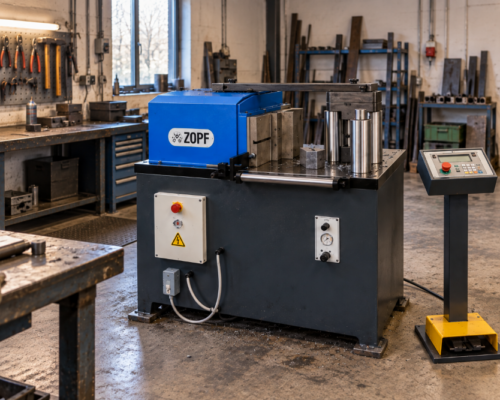
We offer bending services for profiles, tubes and bar stock using the ZOPF T 500 Multi horizontal press. This powerful and precise hydraulic bending press is suitable for producing individual parts and prototypes as well as repeat production in small and medium-sized batches.
Our machine has a maximum pressing force of 500 kN (50 tonnes). Thanks to adjustable hydraulic pressure and bending speed, the process can be adapted to the material, profile cross-section and required bending radius.
What can we bend?
The ZOPF T 500 Multi enables us to carry out a wide range of metal forming and bending operations. We can bend sheet and flat bar, solid profiles, square and rectangular hollow sections, round tubes and various special profiles. In addition to standard bending operations, we can design and manufacture dedicated tooling for specific parts.
One of the key advantages of this machine is its ability to perform bending operations that can be difficult to achieve with a conventional press brake or standard tube bending machine. With purpose-built tooling, for example, we can bend profiles to tight internal radii while controlling the profile geometry and reducing the risk of crushing or unwanted deformation.
Custom tooling for specific parts
Not every bending operation can be performed efficiently with universal tooling. Where required, we can design and manufacture dedicated bending tools and fixtures for a specific component or profile.
This allows us to handle non-standard applications, including special profile shapes, repeated bends, tight bending radii and components where dimensional accuracy and repeatability are particularly important.
The machine’s maximum tool height of 300 mm and 700 × 1250 mm working table provide ample space for larger and more complex tooling. The quick tool-change system also enables efficient changeovers between different jobs.
Repeatable and programmable bending
The ZOPF T 500 Multi NC control can store up to 99 programs, each with up to 16 operating steps. This is particularly useful for series production where the same component needs to be produced repeatedly.
Programmable operating cycles help ensure that subsequent parts are manufactured using the same settings as the approved first part. This enables us to offer both one-off bending work and efficient small- and medium-batch production.
ZOPF T 500 Multi – Technical Capacity
| Technical specification | Capacity |
|---|---|
| Maximum pressing force | 500 kN / 50 t |
| Hydraulic pressure | up to 200 bar, adjustable |
| Maximum stroke | 285 mm |
| Maximum working speed | 10 mm/s |
| Return speed | 20 mm/s |
| Working table dimensions | 700 × 1250 mm |
| Maximum tool height | 300 mm |
| Working table height | 930 mm |
| Motor power | 5.5 kW |
| Machine weight | approx. 1,400 kg |
| Bending capacity with V-die* | up to 300 × 15 mm |
| Round tube bending capacity* | up to Ø76 × 4 mm |
| NC programs | up to 99 programs / 16 steps each |
* Manufacturer’s specifications for material with a tensile strength of Rm 400 N/mm². Actual bending capacity depends on the material, profile geometry, bending radius and tooling used.
How can we help?
We can assist with anything from a straightforward bending operation to a complete technical solution. We can assess the bendability of the component, select the most suitable bending method, design and manufacture dedicated tooling or fixtures where required, produce trial parts and carry out subsequent batch production.
If you have a component that is difficult to bend using conventional methods, send us a drawing or 3D model together with the material specification, profile dimensions, wall thickness, required bending angle and bending radius. Based on this information, we can assess feasibility and determine the most suitable manufacturing solution.
Sheet Metal and Flat Bar Bending
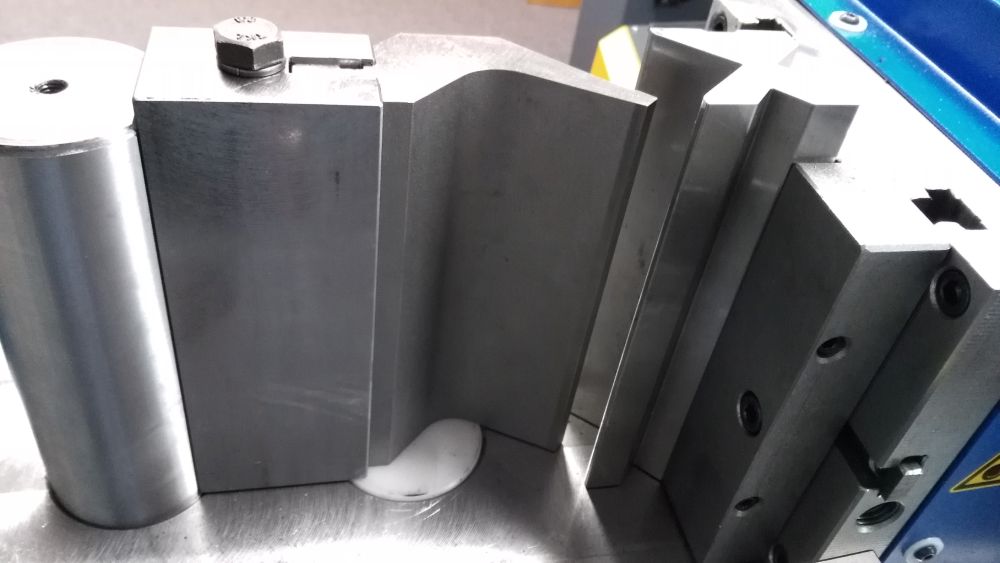
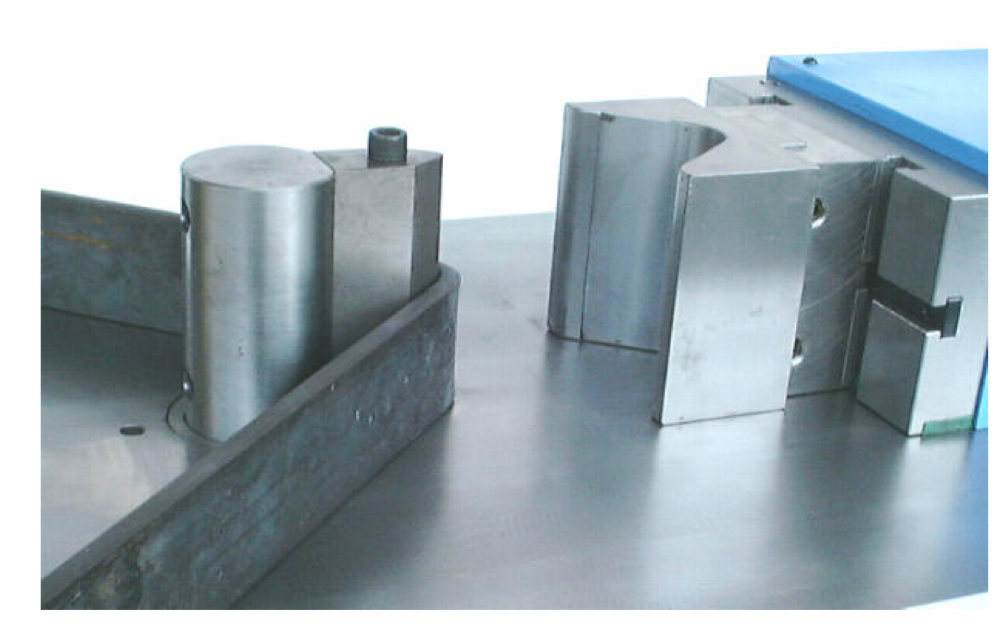
With our ZOPF T 500 Multi horizontal press, we provide precision bending of sheet metal and flat bar using a range of punches and bending tools. The machine’s 500 kN (50-tonne) pressing force allows us to handle heavy-duty components and large cross-sections. The maximum tool height is 300 mm, and with suitable tooling, we can bend flat bar up to 15 × 300 mm.
The programmable control system is particularly useful for components requiring multiple bends with different angles or bending depths. A single program can contain up to 16 different operating cycles, allowing the operator to perform consecutive bends according to predefined settings. This reduces the need for manual adjustments, speeds up production and ensures a high level of repeatability from part to part.
Using different punches and bending tools, as well as custom-made tooling where required, we can produce everything from simple angle bends to more complex components with multiple consecutive bends. The programmable process makes the machine suitable for one-off parts and prototypes as well as efficient small- and medium-batch production.
The result is a flexible, fast and cost-effective bending service, particularly for components that require several different bending angles or positions within a single production process.
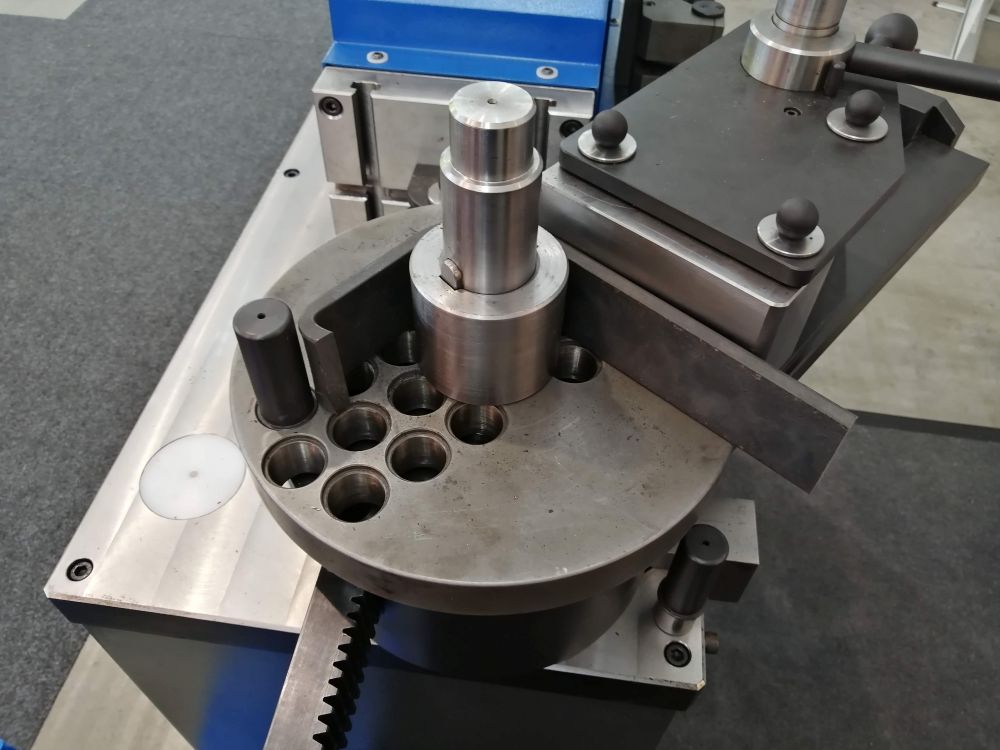
Flat Bar Bending with a Rotary Bending Tool
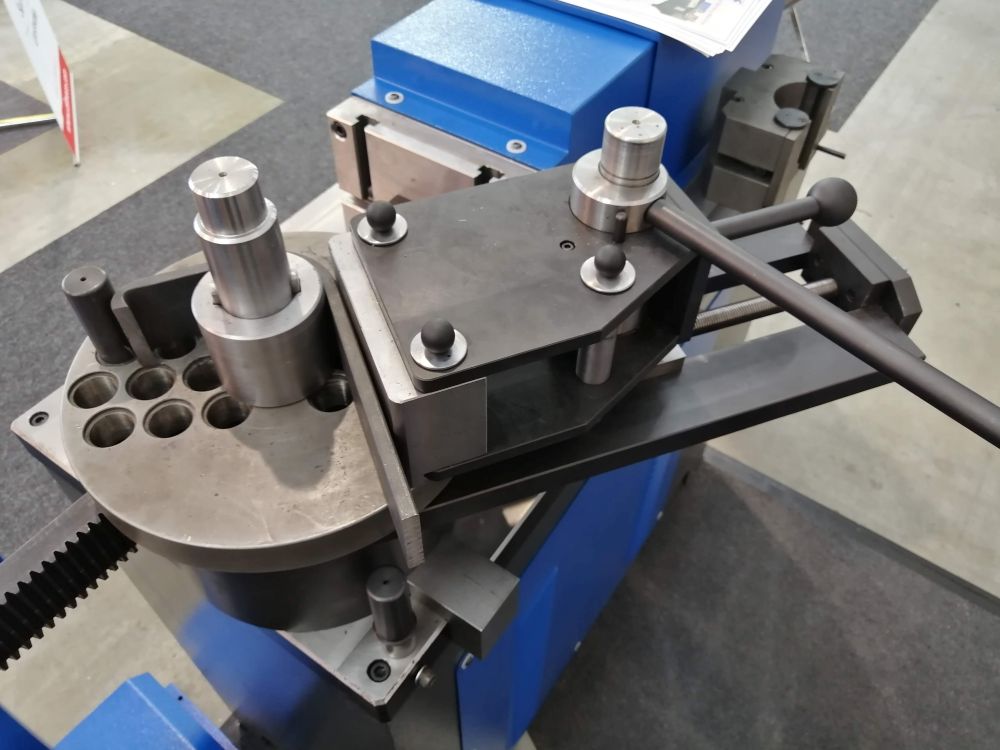
A specially designed rotary bending tool allows flat bar to be bent in a controlled manner around a bending former with a defined radius. Compared with conventional punch and V-die bending, the operating principle is different: instead of simply pressing the material between two tools to a specified depth, the linear movement of the press is converted into a controlled rotary motion.
At the start of the bending process, the flat bar is positioned between the bending former and the supporting element. As the press advances, the rotating section of the tool begins to move around the central bending axis. The bending roller or support follows the rotary arm and gradually forms the flat bar around the fixed-radius former. The material remains supported by the tooling throughout the operation, allowing it to follow the outer surface of the former until the required bending angle is reached.
One of the main advantages of this method is that the bending radius is primarily determined by the geometry of the bending former. By changing the central former and adjusting the supporting elements, the same basic tool can be adapted for different flat bar dimensions, bending radii and component geometries. Dedicated tooling can also be designed for specific products where the required result cannot be achieved efficiently with conventional bending methods.
Rotary bending is particularly suitable for producing components with tight and accurately defined internal radii, bending heavier flat bar, and achieving consistent results in repeat production. As the material is progressively formed around the former, the bending process is smooth and the material follows a controlled, predefined geometry.
The ZOPF T 500 Multi combines a 500 kN pressing force with a programmable working stroke, allowing the movement of the rotary bending tool to be accurately controlled. Up to 16 different operating steps can be stored within a single program, making it possible to manufacture components requiring several bends with different angles or bending positions. Once the tooling and program have been set up, the same process can be repeated quickly and consistently for subsequent parts.
The result is a flexible bending solution for one-off components as well as small- and medium-batch production. Where required, we can design and manufacture a dedicated bending former or complete tooling system based on the flat bar dimensions, material, required bending radius and final component geometry.
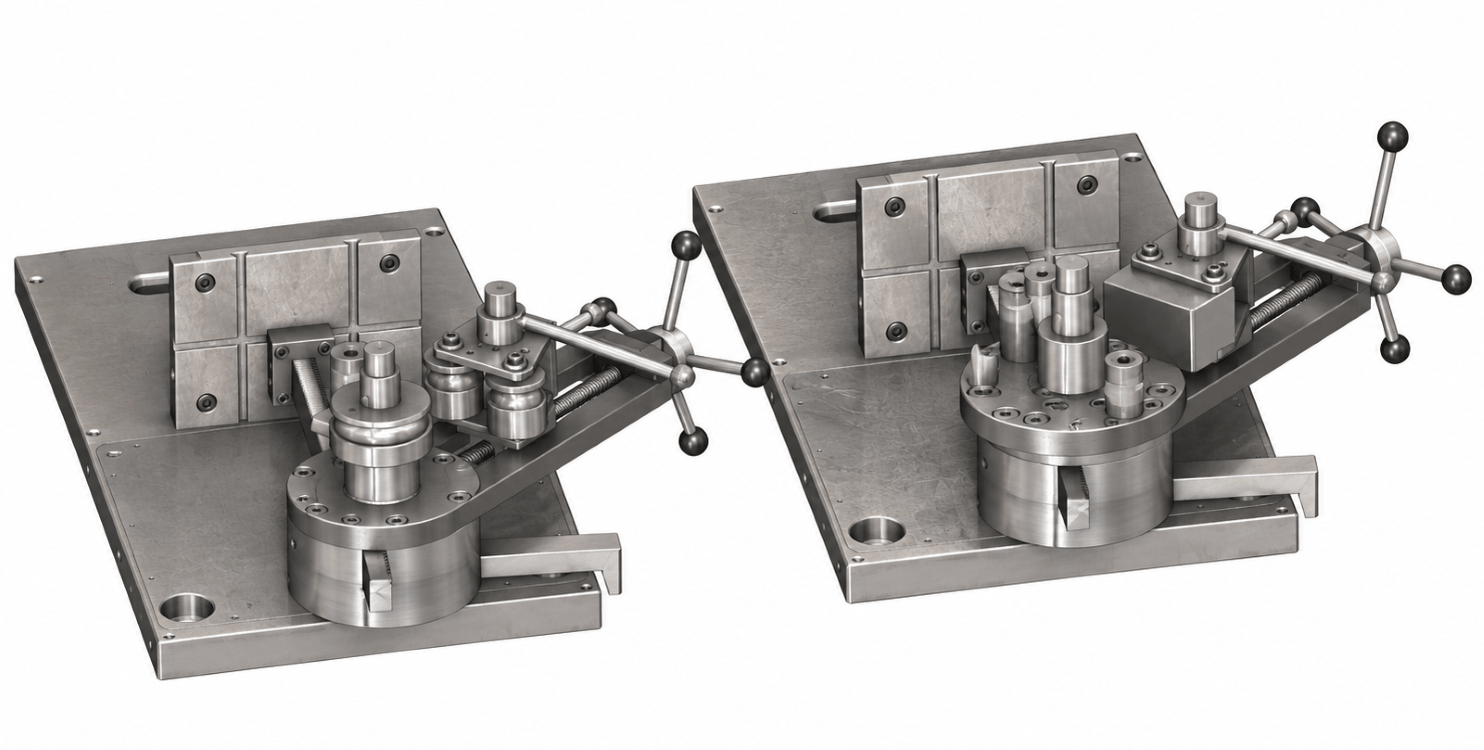
Tube and Profile Bending with Interchangeable Rollers
The same rotary bending principle can also be used for bending tubes and various hollow sections. The bending former and guide rollers are changed to match the dimensions and shape of the tube or profile being processed.
A grooved bending former and matching rollers support the tube throughout the bending process and guide it smoothly around a predefined radius. The operating principle is therefore similar to that of a rotary-draw tube bending machine: rather than bending the tube freely between two points, the material is guided around a bending former with a defined geometry. With the correct tooling, this helps maintain the tube’s cross-sectional shape while producing a more accurate and consistent bending radius.
By using interchangeable formers and rollers, the same basic bending fixture can be equipped with tooling sets for round tubes of different diameters, as well as square, rectangular and special profiles where required. This dedicated tooling significantly extends the capabilities of the ZOPF T 500 Multi beyond conventional press bending, allowing it to perform controlled rotary bending of tubes and profiles.
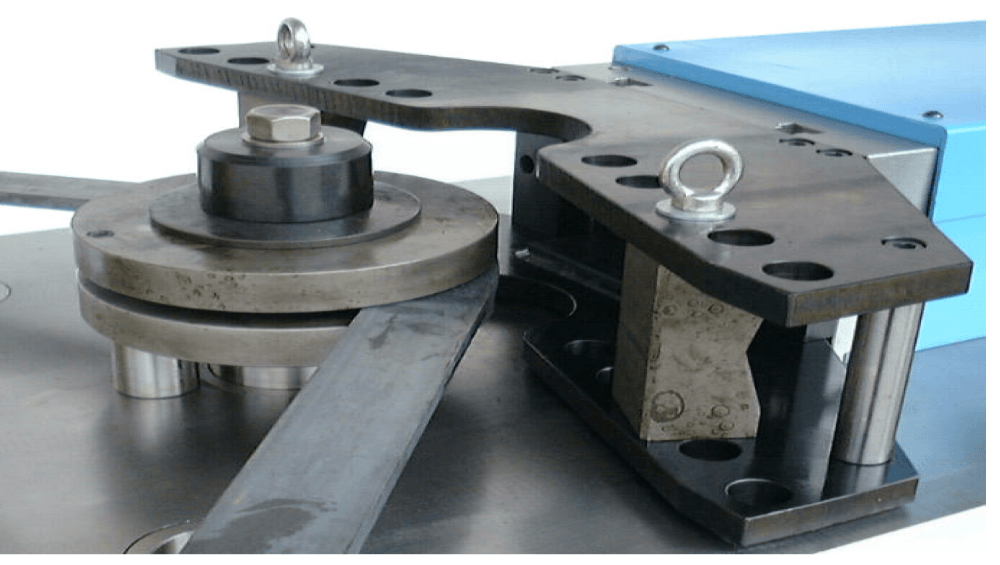
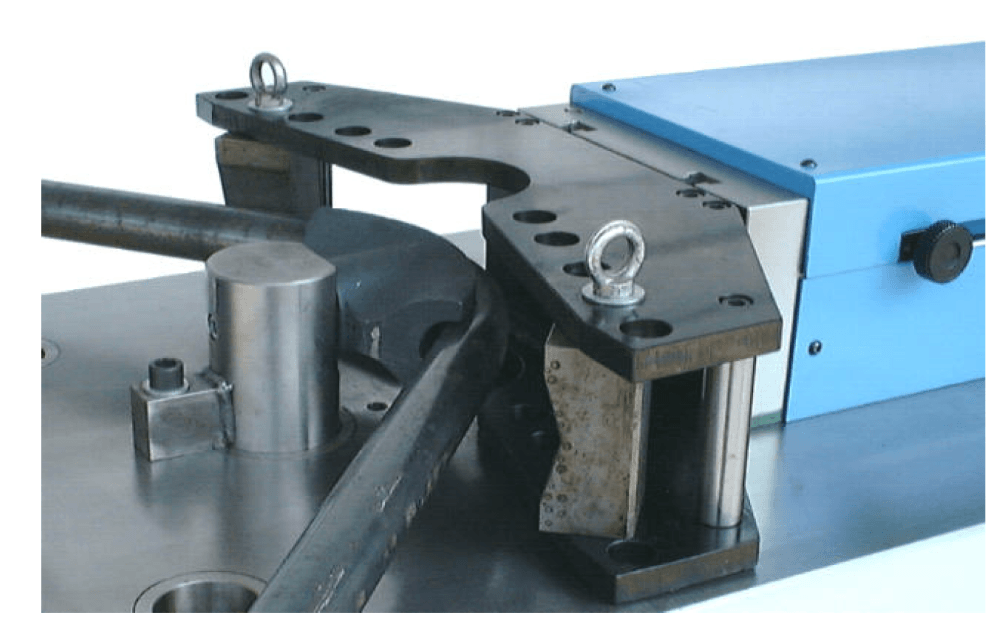
Forming Profiles and Bars by Pressing
In addition to conventional bending, the ZOPF T 500 Multi allows us to form a wide range of profiles and bars using dedicated press tooling. With the appropriate tooling, we can process flat bar, angle iron, round and square bars, as well as tubes of various diameters. The tooling supports and guides the material throughout the forming process, helping to maintain the profile shape and reduce unwanted twisting, buckling or distortion.
Flat bar and angle iron can be formed to a predefined radius using specially designed tooling that keeps the material guided and supported during the entire operation. This is particularly important for longer components and larger bends, where unsupported profiles may otherwise tend to twist or deform sideways.
For tubes and other hollow sections, we can use custom tooling designed for a specific diameter and required bending radius. The tooling supports the profile during forming and gives the component its predefined geometry. The tool design is selected according to the profile dimensions, wall thickness, material properties and required final shape.
The ZOPF T 500 Multi is also particularly well suited to repeat production using custom-made tooling. When identical components are required in larger quantities, we can design dedicated forming tools for producing various curves, waves and other decorative or functional shapes in round and square bars, flat bar and other profiles. The programmable press stroke helps ensure consistent geometry and repeatable results throughout the production batch.
Components produced using this method can be used in balcony and stair railings, gates, fences, handrails, metal furniture and a wide range of decorative metal structures. The ability to design and manufacture dedicated tooling also provides considerable flexibility for custom components – production can be based on a finished technical drawing, a sample part or simply the required shape.
Gallery
Examples of various projects we have completed over the years, providing a better overview of the bending, forming and custom tooling capabilities of the ZOPF T 500 Multi.
Request a Quote